Executive Summary (TL;DR)
When CTOs, CIOs, and other IT business decision makers are budgeting for AI infrastructure in 2026, he should be aware of neocloud providers with spot instance offers due to the:
- Serious Savings: GPU spot instances offer 60–90% discounts over on-demand rates by utilizing spare cloud capacity. They are the single most effective lever for developers and IT leaders at midmarket firms to maximize their AI R&D and inference budgets.
- Strategic Advantage: While hyperscalers (AWS, Microsoft Azure, Google Cloud) provide the foundational market, specialized AI GPUaaS neocloud providers (e.g., Nebius, CoreWeave, Lambda) offer superior hardware availability and tailored preemption policies for AI workloads.
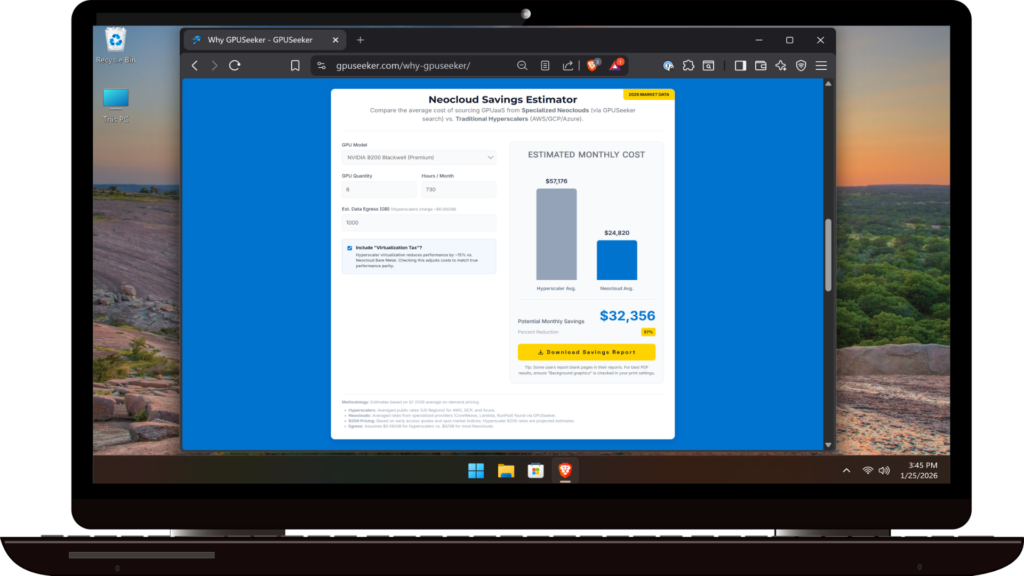
- GPUSeeker Impact: Transitioning from hyperscaler on-demand to neocloud spot instances frequently yields 50% or more in cost savings, as demonstrated by the GPUSeeker neocloud cost savings estimator.
- Risk Mitigation: Success using spot instances in your AI projects requires a proactive architecture featuring robust checkpointing and a multi-cloud orchestration strategy to handle variable preemption notice periods ranging from 0 to 120 seconds.
What Are GPU Spot Instances? The Essential Definition
GPU spot instances represent a highly cost-effective cloud computing model that enables users to access virtual machine (VM) instances from a provider’s excess or underutilized compute capacity. The term spot instance came out of how Amazon Web Service (AWS) had massive cloud compute capacity and users could reserve a temporary instance of their unused/spare Amazon Elastic Compute Cloud (EC2) for a steep discount. The only downside was the fact your cheap reservation on that EC2 compute instance could go away on the spot with little to no warning if another AWS customer needed more EC2 capacity for their big project.
It’s no longer just AWS, as cloud providers today offer spot instances to monetize their spare capacity. The economic appeal of spot instances are undeniable: Google Cloud’s Spot VMs offer 60-91% discounts, while Microsoft Azure provides up to 90% off pay-as-you-go prices. Similarly, AWS EC2 Spot Instances can be up to 90% cheaper than On-Demand pricing. For midmarket AI firms, these percentage savings translate into millions of dollars annually, making previously cost-prohibitive activities—such as extensive hyperparameter tuning and continuous model retraining—economically viable.
In terms of AI GPU infrastructure, the spot market allows neocloud providers to continue to make money on their expensive GPU hardware investments that would otherwise remain idle while also offering customers the opportunity to leverage powerful GPUaaS at significantly reduced rates. But AI innovators and IT business leaders must understand how spot instances provided by the big hyperscalers and specialized neoclouds can affect their AI projects’ budgets and timelines.
What Are the Ideal AI Workloads for Spot & Interruptible Instances?
Spot and interruptible GPUs are great for:
- Batch inference at scale (non-real-time)
- Distributed training with frequent checkpointing to persistent storage
- Hyperparameter tuning and experimentation
- Development, testing, and CI/CD pipelines
- Any flexible-deadline workload
They are less suitable for latency-sensitive production inference without hybrid fallback (on-demand reserves).
Engineering AI for Hyperscaler Preemption Models
Understanding how major cloud providers handle interruptions is critical for engineering teams designing fault-tolerant AI pipelines:
- Google Cloud (Spot & Preemptible VMs)
Google Cloud Spot VMs (formerly Preemptible VMs) offer up to 91% discounts with a 30-second preemption notice and 24-hour maximum runtime. However, Google Cloud Spot VMs can be stopped at any time due to system events or capacity needs.
- Notice Period: Google provides a graceful shutdown notice in the form of an ACPI G2 Soft Off signal. If the instance does not stop within this window, an ACPI G3 Mechanical Off signal is sent.
- Billing Policy: Google typically does not charge for the VM or attached GPUs if preemption occurs within the first minute of creation.
- Microsoft Azure (Spot Virtual Instances)
Azure Spot VMs are ideal for dev/test and batch processing. Microsoft will sell you Azure Spot VMs at a discount of up to 90% off reserve instance pricing but with eviction based on capacity or user-defined max price.
- Eviction Triggers: Workloads can be evicted when Azure needs to reallocate capacity or when the current Spot price exceeds the “maximum price” the user agreed to pay.
- Strategic Lever: This maximum price setting provides a predictable budget cap, though a lower cap increases preemption risk.
- Amazon Web Services (EC2 Spot Instances)
AWS offers a wide array of GPU-optimized instances (P4d, G5, etc.) as spot resources. Many developers have noted that AWS using Auto Scaling Groups can handle spot instance replacement effectively.
- Notice Period: AWS provides a 2-minute interruption notice, offering a more generous window than Google for applications to save progress.
- Pricing Stability: Prices adjust gradually based on long-term supply and demand trends rather than a direct, continuous bidding auction, providing greater price stability for long-running tasks.
Why AI Innovators are Shifting to Neocloud Providers
While hyperscalers are the starting point, midmarket AI firms are increasingly turning to specialized neocloud providers. The economic driver for spot instance usage in AI development on neocloud GPUaaS infrastructure is identical to their hyperscaler competitors: cloud providers monetize their spare capacity while users gain substantial savings. Midmarket AI teams benefit from neocloud resources because the infrastructure is specialized for AI inference and training, often with better dev tools and platforms.
Neocloud providers (e.g., Vast.ai, Runpod, Lambda) use similar interruptible models, often auction-based or paused rather than terminated. Vast.ai, for example, pauses lower-bid instances when higher bids arrive, enabling rapid resumption without full data loss. These AI GPUaaS providers offer more direct access to high-demand silicon (e.g., NVIDIA H100s, B200s) and often provide even deeper savings than the Big Three cloud hyperscalers.
This table shows a concise summary of the spot instance offers (as of January 2026) from top neocloud AI GPUaaS providers:
Provider | Preemption Policy | Why They Win for AI |
60-Second SIGTERM | One of the longest notice periods in the specialized market; superior for large-scale training. | |
30-Second SIGTERM | Kubernetes-native infrastructure with InfiniBand clusters, designed specifically for ML at scale. | |
SIGTERM / Varies | High availability of NVIDIA A100/H100s with a focus on deep learning developer experience. | |
30-Second ACPI | Global footprint with standardized preemption across both NVIDIA and AMD GPU types. | |
Abrupt (0-Second) | Offers the absolute lowest price-per-hour for stateless inference and community-driven pods. | |
Paused (Not Terminated) | A decentralized marketplace where instances are paused if outbid, significantly reducing data loss compared to full termination |
The Economic Comparison of Spot Instances for AI
Midmarket CTOs must look at the total cost of ownership (TCO). While AWS or Azure might offer 90% off their own on-demand rates, the baseline on-demand rates at neocloud providers are often significantly lower from the start.
The GPUSeeker.com cost savings estimator shows that AI developers consistently can achieve 50% or more in savings by choosing AI spot instances (sometimes they call them “on-demand” instances) in neocloud GPUaaS providers over the Big Cloud hyperscaler options.
Mitigating Risk: Engineering for the Spot Instance Reality
To successfully leverage the steep discounts gained by using AI GPUaaS spot instances, your infrastructure must be proactive rather than reactive. If you haven’t already, prepare your AI projects with these non-negotiable aspects:
- Robust Checkpointing: Essential for training. Frameworks must regularly save weights and states to persistent storage like Amazon S3 or Google Cloud Storage.
- Stateless Design: AI inference should be designed as stateless where possible, externalizing state management to ensure service continuity during interruptions.
- Notice Monitoring: Implementing monitoring for preemption notices (e.g., using AWS EventBridge for the 2-minute warning) allows for automated graceful shutdown scripts.
- Multi-Cloud Orchestration: Do not rely on a single region or provider. Use GPUSeeker to find inexpensive neocloud GPU rentals across a global footprint to ensure you can instantly shift workloads if capacity tightens.
Strategic AI GPUaaS Recommendations for CTOs and CIOs
Selecting the right AI infrastructure depends on your project’s specific interruption tolerance:
- For Model Training: Prioritize AWS (2-min notice) or Nebius (60-sec notice) to protect long-running stateful progress.
- For Batch Inference: Use RunPod or Vultr for the lowest possible cost-per-token.
- For Diverse R&D: Leverage ai to access over 10,000 GPUs, including consumer-grade cards like the RTX 4090 which are often scarce on hyperscalers.
- For Hybrid Optimization: Complement GPU spot usage with AWS Graviton CPUs for data preprocessing to achieve up to 40% better price/performance in the overall pipeline.
For organizations focused on consuming Foundation Models without managing infrastructure, CTOs and CFOs alike should consider services like AWS Bedrock offer cost efficiencies via prompt caching and model distillation, as this potentially helps save up to 90% at the application layer.
In the 2026 AI infrastructure landscape, knowing the pros and cons of GPU spot instances is a competitive necessity. GPUSeeker was founded to help AI innovators and IT business decision makers to avoid the Hyperscaler Tax. We help you to search, compare, and book the specialized neocloud GPUaaS resources needed for AI projects. We specialize in helping organizations in healthcare, retail, financial services, manufacturing, and media.
Search and Compare AI GPU Prices on GPUSeeker.com
Searching our vetted neocloud partners is always free and midmarket firms can effectively double their compute capacity for the same capital outlay.