Executive Summary (TL;DR)
- Free Isn’t Free: Legacy hyperscalers use initial “free” credits (often $100k+) to create deep ecosystem integration, leading to vendor lock-in once credits expire and 4X market rates kick in.
- The Gravity of Egress Fees: While ingress is free, moving data out of legacy clouds costs $0.09–$0.12 per GB. For a 1PB dataset, this results in a $90,000+ ransom fee just to migrate.
- The Managed Service Tax: Proprietary platforms like AWS SageMaker or Google Vertex AI add massive markups. Raw compute on an NVIDIA H100 costs ~$2.50/hr on Neoclouds vs. $12.00+/hr on legacy on-demand instances.
- Hidden Profit Killers: Beyond GPUs, secondary charges for NAT Gateways, CloudWatch logging, and API Gateway request fees can exceed the cost of the underlying inference.
- The 60% Repatriation Rule: Per Deloitte, once cloud spend hits 60–70% of on-premise costs, enterprises should migrate to Neoclouds or hybrid models.
- Strategic Advantage: In 2026, Neoclouds like CoreWeave and Lambda now match legacy providers on compliance (HIPAA, GDPR, SOC2), removing the final barrier to migration.
How Free Big Cloud Credits Trap AI Developers
In the AI gold rush times of 2024 and 2025, the mantra for every CTO and CIO was move fast and break things. Cloud hyperscalers like AWS, Google Cloud, and Azure were happy to facilitate this, firing off more salvos of “free” credits to AI developers at every tech conference. But it’s safe to say things are looking more… realistic now in 2026. The credits have dried up, the invoices are arriving, and many organizations are realizing that their cloud-native AI strategy is built on a foundation of hidden fees that are actively cannibalizing their ROI.
For midmarket companies in data-heavy sectors like healthcare diagnostics and quantitative finance, the cost of moving data (egress) and the “managed service tax” have become the two greatest barriers to scaling AI production. In part 3 of our 5-part blog series, we’re outlining why the “free” entry point of legacy clouds is often a trap and how the shift toward neoclouds and transparent pricing is saving the bottom line for the next generation of AI leaders.
Big Cloud Bait & Switch: The Reality of Free Credits
The strategy used by legacy hyperscalers is the equivalent of selling crack (or so I’ve heard):
- Step 1: Offer $100,000 in credits to get a company’s entire dataset into their ecosystem (e.g., S3, GCS, or Azure Blob).
- Step 2: Give the corporate IT and dev teams at the company some hand-holding service to make sure everything works.
- Step 3: Once the company’s models, pipelines, and data are so deeply integrated that they’re effectively locked in once those “free” credit expire.
At that point, the cost to move all those models, pipelines, and data is so high that it would cost your company more to leave than to work through the pain. So, it’s more precise to say this business model is half drug deal/half holding your data for ransom.
Research from IDC in late 2025 backs this up, suggesting that CIOs will underestimate AI infrastructure costs by 30% through 2027, largely due to what they term as “gravity fees.” Your credits run out and the AI developers who were once “experimenting for free” are suddenly paying 3–4X the market rate for GPU hours along with a mess of secondary charges that never appeared on the initial quote.
The Gravity of Data Egress Fees
Data egress is the fee charged by a cloud provider to move data out of its network. While ingress (moving data in) is almost always free, getting your data back out is where the costs spiral. So, your company’s large datasets accumulated over time with all of the various applications and services connected to your data has a major cost to move. It’s as if your data is so big it’s got a gravitational pull, making data migration out of whatever cloud you use costly due to the egress fees.
Gravity fees are a concern for any organization or developer working on cloud-native AI solutions. Be aware of these key aspects of AI GPUaaS data egress to reduce potential gravity fees:
- Hyperscaler Reality: AWS, Azure, and GCP typically charge between $0.09 and $0.12 per GB for data transfer to the internet. For a medical imaging company processing 1 petabyte (1,000,000 GB) of training data, a single migration or even significant external inference could cost $90,000 to $120,000 in egress fees alone.
- The Neocloud Counter-Attack: In a landmark move on November 13, 2025, CoreWeave launched its Zero Egress Migration (0EM) Not only does CoreWeave charge zero egress for its own services, but it actually offers to pay the ransom for customers migrating large-scale AI workloads away from legacy providers.
- Zero-Fee Leaders: Providers like Lambda Labs and Runpod have built their entire business models on “Zero Egress” policies. That means on RunPod, a 90-second inference job costs exactly 90 seconds of compute—period. No network transfer tax, no hidden API request fees.
The Managed Service “Tax": Convenience vs. Cost
One selling point legacy clouds and hyperscalers tout to CTOs and development managers is convenience. Compared to manual processes, dev teams gain a lot of convenience and peace of mind through managed services like AWS SageMaker or Google Vertex AI. Yes, it’s true these platforms simplify the deployment of models, but they also come with a hefty markup. A high-level comparison of an NVIDIA H100 SXM 80GB illustrates the gap. As of the writing of this blog post in January 2026:
- Runpod: Around $2.69 per hour.
- Lambda: Between $2.20 – $2.50 per hour.
- AWS (On-Demand): Often exceeds $12.00 per hour when including the managed service overhead and proprietary platform fees.
Even after enterprise discounts, hyperscalers can be 2X more expensive for raw compute. For a company running a 1,000-GPU cluster for model fine-tuning, that’s a difference of $9,000 per hour in so-called “convenience.”
What are the Hidden Infrastructure Costs for Hyperscale Cloud?
Beyond the GPU and the data transfer, there are tons of middleman services in legacy hyperscaler clouds that add up:
- NAT Gateways: Essential for private VPCs but often cost $0.045/hour plus a per-GB processing fee that can add thousands to a monthly bill.
- CloudWatch & Logging: High-frequency AI logging can lead to ingestion fees of $0.50/GB. For a multimodal model generating petabytes of logs during training, this can be a silent profit-killer.
- API Gateway Fees: Services like AWS API Gateway charge per million requests. Gartner predicted that 40% of business apps will use agentic AI and those systems make thousands of handshake calls per second. So, it’s safe to say those request fees will quickly exceed the cost of the underlying inference.
What is the ROI for Using Hyperscale Cloud on an AI Project?
It would be wrong to claim there was never a reason to pay the hyperscaler premium when it comes to building an AI solution. However, for AI developers targeting midmarket companies in the financial services, healthcare, streaming media, retail/e-commerce, and manufacturing industries, GPUSeeker.com believes you should consider:
- The 60% Rule: Deloitte research indicates that when cloud costs reach 60–70% of the cost of an equivalent on-premise system, it is time to consider repatriating the workload or moving to a specialized neocloud.
- Integration Depth: If your AI model is purely an enhancement to a massive existing database already on Azure (e.g., a SQL Server with petabytes of historical records), the internal “inter-region” transfer costs might still be lower than moving the data out.
- Compliance Needs: Historically, legacy clouds held the edge here. However, in 2026, neocloud provider Vultr supports HIPAA, GDPR, and SOC2, while CoreWeave and Lambda have achieved similar certifications, removing the security excuse for paying the hyperscaler tax.
What Role Does Vendor-Neutral Search Play in Reducing AI Costs?
The complexity of these pricing models is feature not a bug. They do it on purpose because it makes a true apples-to-apples comparison nearly impossible for a human procurement team. This is why specialized search tools have become mandatory for AI infrastructure leads in 2026.
GPUSeeker.com empowers AI developers to filter not just by the chip (e.g., search for available NVIDIA H100s), but by other financially-relevant aspects of choose GPUaaS. Our near real-time indexing of neocloud pricing on spot instance availability, max total pricing, and we partner with all of the providers offering zero egress fees. This allows you to see the true cost before ever uploading a single byte of data.
Eliminating Hidden Cloud Costs with GPUSeeker.com
In 2026, AI success is no longer about who has the biggest model, but who has the most efficient unit economics for inference and training. Those who continue to pay a 300% markup with a legacy Big Cloud provider for the sake of convenience will find their margins squeezed by competitors who migrated to neocloud GPUaaS.
The “Hidden Cost of Free” is the most expensive lesson a modern CTO can learn. Don’t wait for your credits to expire to find out what your ROI actually looks like.
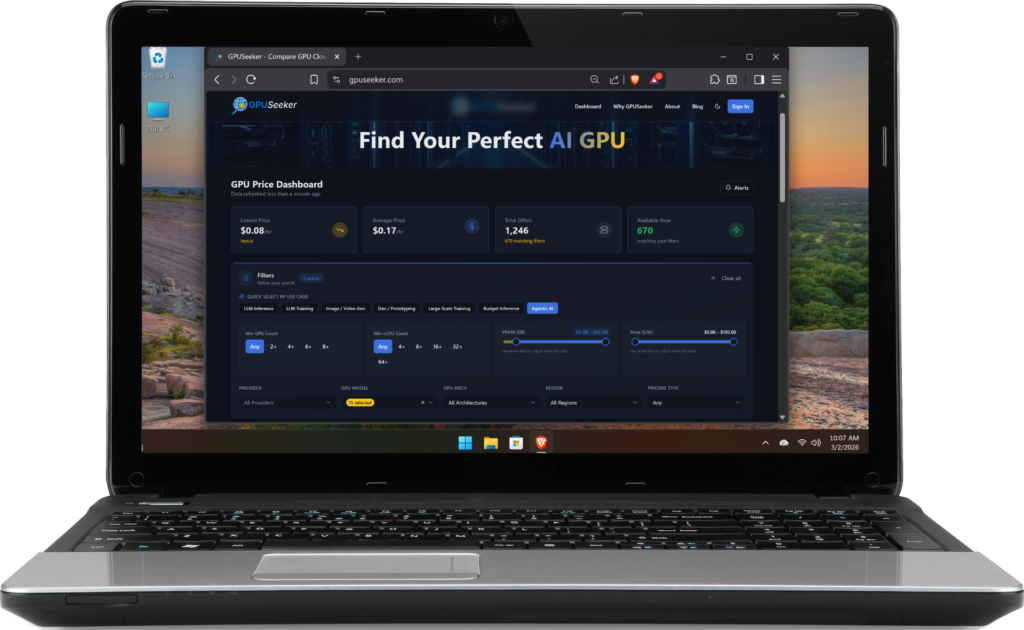
Ready to eliminate the Big Cloud hidden costs? Visit GPUSeeker.com today to compare transparent pricing from the world’s leading AI cloud providers. Filter by egress fees, compliance certifications, and real-time availability to ensure your AI project scales on your terms—not your cloud provider’s.
In our penultimate post in this series, we’ll cover The Buy vs. Rent Strategic Dilemma: Calculating Your AI TCO