
TL;DR
- GPU scarcity will likely be a real problem for midmarket AI teams through December 31, 2026.
- The real constraint for midsized firms during GPU shortage 2026 is effective compute access, not just list price.
- Neoclouds such as Nebius, Runpod, Vast.ai, and Hydra Host provide faster access, smaller commitments, and better-aligned options than hyperscaler queues.
- NVIDIA Rubin GPUs and HBM4 advances matter but will not eliminate 2026 scarcity.
The global scarcity of AI compute hardware is a major constraint across multiple industries. The hardest hit are midmarket organizations facing “GPU Shortage 2026.”
Their AI projects’ bottleneck is no longer only GPU availability. Midmarket orgs are are feeling real operating constraints due to limited supplies of AI GPUs, high bandwidth memory (HBM), NAND/SSD storage, and rack power.
This is the common thread running through the April 2026 analyses from Tomasz Tunguz, Clarifai, Spheron, and Data Center Knowledge. It’s reinforced by primary disclosures from major tech companies like Alphabet, NVIDIA, and even the U.S. Department of Energy.
The evidence supports a clear planning assumption for companies with 250–1,000 employees and $200M–$1B in revenue: between now and December 31, 2026, compute will stay tight. Contracts on GPU capacity will stay less buyer-friendly, and the firms that move fastest will be the ones that win.
In that environment, neocloud providers such as Hydra Host, Nebius, Runpod, and Vast.ai look less like niche vendors and more like the most pragmatic bridge through a constrained year.
Why will GPU scarcity persist through year-end 2026?
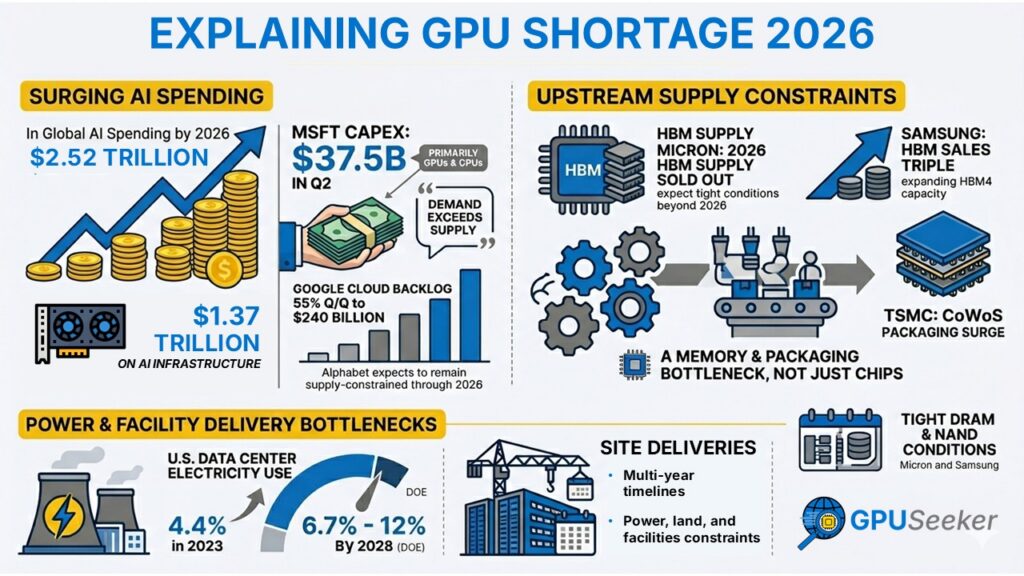
- Demand is not cooling. Gartner forecasts $2.52 trillion in worldwide AI spending in 2026, including $1.37 trillion on AI infrastructure. Microsoft spent $37.5 billion of capex in FY26 Q2, with roughly 2/3 on short-lived assets like GPUs, and still said demand exceeds supply. Alphabet said Google Cloud’s backlog grew 55% quarter over quarter to $240 billion. Even then, Google expects to remain supply-constrained through 2026.
- Supply is constrained upstream. Micron says it has agreements on price and volume for its entire 2026 HBM supply and expects tight conditions to persist beyond 2026. Samsung says its HBM sales should more than triple in 2026 as it expands HBM4 capacity. TSMC says CoWoS has experienced strong growth since 2023 because of surging AI demand. That is why the shortage is better understood as a memory-and-packaging bottleneck than a simple chip shortage.
- Power and facility delivery are bottlenecks, too. The DOE says U.S. data centers used about 4% of total electricity in 2023 and could reach 6.7% to 12% by 2028. Microsoft says capacity additions depend on power, land, and facilities, with major sites described as multiyear deliveries.
On the storage side, Micron expects tight DRAM and NAND conditions through and beyond 2026, while Samsung says it is proactively scaling AI-related NAND/SSD supply for inference demand. Product announcements alone do not solve those physical constraints.
Why are midmarket companies at risk during GPU shortages?
Supply constraints matter because AI is already mainstream in the middle market. RSM’s 2025 middle-market AI survey, based on 966 responses, found that 91% of respondents are using generative AI. Among those users, 25% say it is fully integrated into core workflows and 43% say it is integrated into some workflows.
Midmarket buyers are not “waiting to see.” They already have workloads, internal expectations, and delivery deadlines.
So, the cost problem for midsized companies with strategic AI projects is less “headline price” and more effective cost of delivered compute. Tomasz Tunguz highlighted NVIDIA Blackwell GPU rental pricing at $4.08 per hour, up 48% from $2.75 two months earlier, and noted tighter terms.
Clarifai and Spheron both describe 36–52 week lead times for data-center GPUs and argue that HBM plus advanced packaging—not GPU die production alone—are the structural constraint.
For midmarket firms, that translates into slower pilots, delayed launches, overprovisioned reservations, and more margin pressure on customer-facing AI products.
The hyperscalers remain essential, but their scale cuts both ways in a constrained year. Microsoft and Alphabet are both balancing incoming supply across multiple priorities. The bottom line: midmarket GPU buyers are competing inside somebody else’s internal prioritization model.
Why do neoclouds look better than hyperscalers for the next 6–8 months?
Due to global GPU shortage 2026, neoclouds deserve more attention from business IT leaders. They are built to sell GPU access first, not as one scarce resource inside an enormous cross-portfolio allocation system.
What midmarket buyers can get from neoclouds right now is materially better aligned to how they buy and ship AI:
- Nebius offers H200 on-demand from $3.50/GPU-hour with no waiting list or long-term commitment for smaller deployments, self-service access to H100, H200, and B200 clusters with no waitlists or minimum commitments, and thousand-GPU clusters in Europe and the U.S. It also advertises multi-month reservation discounts up to 35%.
- Runpod offers H200 and B200 instances from $3.59/hour on-demand based on GPUSeeker’s latest pricing, with per-second billing, instant clusters, and persistent storage options. That is a much cleaner fit for bursty experimentation, fine-tuning, and intermittent production inference than traditional enterprise-style reservations.
- Vast.ai positions itself as an elastic GPU marketplace: start with $5, no contracts, no minimums, with on-demand capacity across 40+ data centers and 20,000+ GPUs, and live pricing driven by supply and demand. For price-sensitive midmarket buyers, that pricing transparency is not a small feature; it is a procurement advantage.
- Hydra Host is aimed more at teams that need larger reserved clusters than marketplace-style spot capacity. It advertises 10,000+ GPUs worldwide and supports both on-demand and long-term deployments, with active examples that include clusters as large as 1,024 x H100. For midmarket firms that need committed training windows but do not want hyperscaler complexity, that is an attractive middle ground.
The pattern is what matters: faster access, smaller increments, cleaner price discovery, and GPU-centric product design. Neoclouds don’t repeal physics by creating net-new HBM and megawatts. But they do help midmarket buyers bypass some of the procurement friction in a constrained year.
What should midmarket AI GPU buyers do in the next 90 days?
There are five actions IT business-decision makers and AI development leaders can take today to position their organizations for success during the current GPU scarcity problem:
- Reserve baseline Q3/Q4 capacity now, preferably on one primary neocloud and one secondary failover provider.
- Architect for H100/H200/B200 portability instead of assuming one “perfect” SKU will remain available.
- Separate premium from non-premium workloads: frontier training, fine-tuning, batch inference, and real-time inference should not all run on the same class of capacity.
- Plan for GPU FinOps at the workload level: track cost per training run, cost per million tokens, queue time, GPU utilization, checkpoint loss, and storage adjacency.
- Keep governance where it belongs, but move elastic compute where it clears fastest: many teams will still keep identity, data controls, and core enterprise services on hyperscalers while shifting GPU-heavy bursts to neoclouds.
What’s the outlook for businesses needing AI GPUs through December 31, 2026?
The AI GPU scarcity problem is multi-layered and won’t be solved any time soon. Sure, NVIDIA says their Rubin-based GPUs will be available in the second half of 2026, and Samsung and Micron are advancing HBM4. But tight conditions should persist beyond 2026.
GPUSeeker believes the likely outcome is a two-track market. Premium, long-duration capacity remains concentrated among hyperscalers, frontier labs, and the largest enterprises. Specialized GPU clouds absorb a growing share of midmarket demand because they are better optimized for access.
Midmarket companies should not wait for abundant cheap GPUs to return in 2026. For now:
- Treat compute as a portfolio.
- Reserve what you must.
- Optimize what you can.
- Move elastic demand to providers that are structurally aligned to sell GPU access quickly.
How can you overcome GPU shortages in 2026 for your AI project?
GPUSeeker helps business executives and development managers to find and reserve scarce GPUaaS infrastructure matched to your AI project needs. We work with major channel partners and neocloud providers to cut wait times—all at a great price.
Over the next 6–8 months, GPU scarcity won’t let up. See how GPUSeeker helps protect your velocity, margins, and launch schedules.